I Painted Myself a Family
I wake before six and go sit with a room full of friends who wear the faces of everything I am afraid of. On coffee and my great-grandmother, the family I am scared I will never start, and the smiling devil who greets me with his arms open.
I wake around five-thirty, six. Before anything else I try to take slow breaths and be grateful — to remind myself that all of this is a gift, that I'm a lowly servant to the miracle I happen to exist inside. Then I make coffee, which is one of my all-time favorite addictions in this life.
My great-grandmother drank coffee every day until she died at ninety-three. I used to think it was the only reason she lasted so long — that the small daily wanting of it was what got her up, excited, every single morning. I inherited that. I wake up excited for the coffee, and for the day, and to get the painting going. The wanting is the engine. It's a strange thing to admit about a practice of facing death, but for me it begins in being glad to be awake.
When I step up to a canvas — fresh, or one I've been living inside for days — I'm not really trying to make anything. I'm trying to stay with my breath and notice how I feel. Big breath in. One small stroke. It looks like it wants some darkness there. I'm feeding the painting what it asks for, trying to stay attuned enough to hear what it's saying in its silent words.
And somewhere in there — no schedule to it, no trigger I can name — I'll start to cry. Not from sadness. From being so far inside the moment that the whole absurd scale of it arrives at once: the madness, the infinite, this infinitesimally small version of me feeling billions of years press into one alive instant. Sometimes it's plain as that. I am here. I am alive. The point of the painting was never the painting. It was to get me here — present enough that the part of me underneath words can surface for a minute.
I'll be honest about what rises with the tears, because it isn't only awe. It comes up through the chest, near the heart, and then the mind feeds images down into it. One of the things I'm most afraid of in this life is dying before I get to start a family. I've always wanted one. And I've had a near-impossible time finding a partner who wants to stand with me, who loves me for who I actually am. So there's a fear sitting under everything — that I'll run out of time before I get to build the thing I want most.
I think a lot of the painting is me trying to build it anyway. The characters I surround myself with — even the ones wearing the face of death — show up as company. As friends. I'm not alone in that room. I'm surrounded by smiling faces, even when the smiles belong to fear and mortality. Somewhere along the line I made a decision to make friends with this. To paint something that reaches out into the world so other people can see me without my having to explain myself. Maybe that's all it is. A man making a family out of paint so the room isn't empty.
This isn't new in me. It's how I survived being small.
I changed schools constantly as a kid. My parents worked all the time, so I came home to an empty house and learned to keep myself company: taking things apart, chasing whatever I found most fascinating, the esoteric stuff school had no shelf for. I left school in the end; the homework I set myself was so much more interesting than the homework they set me. By sixteen I was teaching myself things years past my grade — not because I was special, but because nobody had built a place soft enough for a mind that open, so I built one.
There was harm in there too, the ordinary unprotected kind that finds a child when the adults who are supposed to stand between him and the world don't. When I was about thirteen, a grown man walked into my classroom, pushed me against the wall, and choked me over something I hadn't even done. We went to court. Nothing happened. What I remember isn't really the hands. It's that there was no one there to protect that kid — so the kid learned to make the world a friendlier place himself, because no one else was going to.
That openness people sometimes mistake for a gift came straight out of the trauma. I found ways to turn what was hurting into something I could live beside. The painting is just the grown version of that. I'm still the kid making friends out of the dark so the dark has company in it.
There's one I'd introduce you to first.
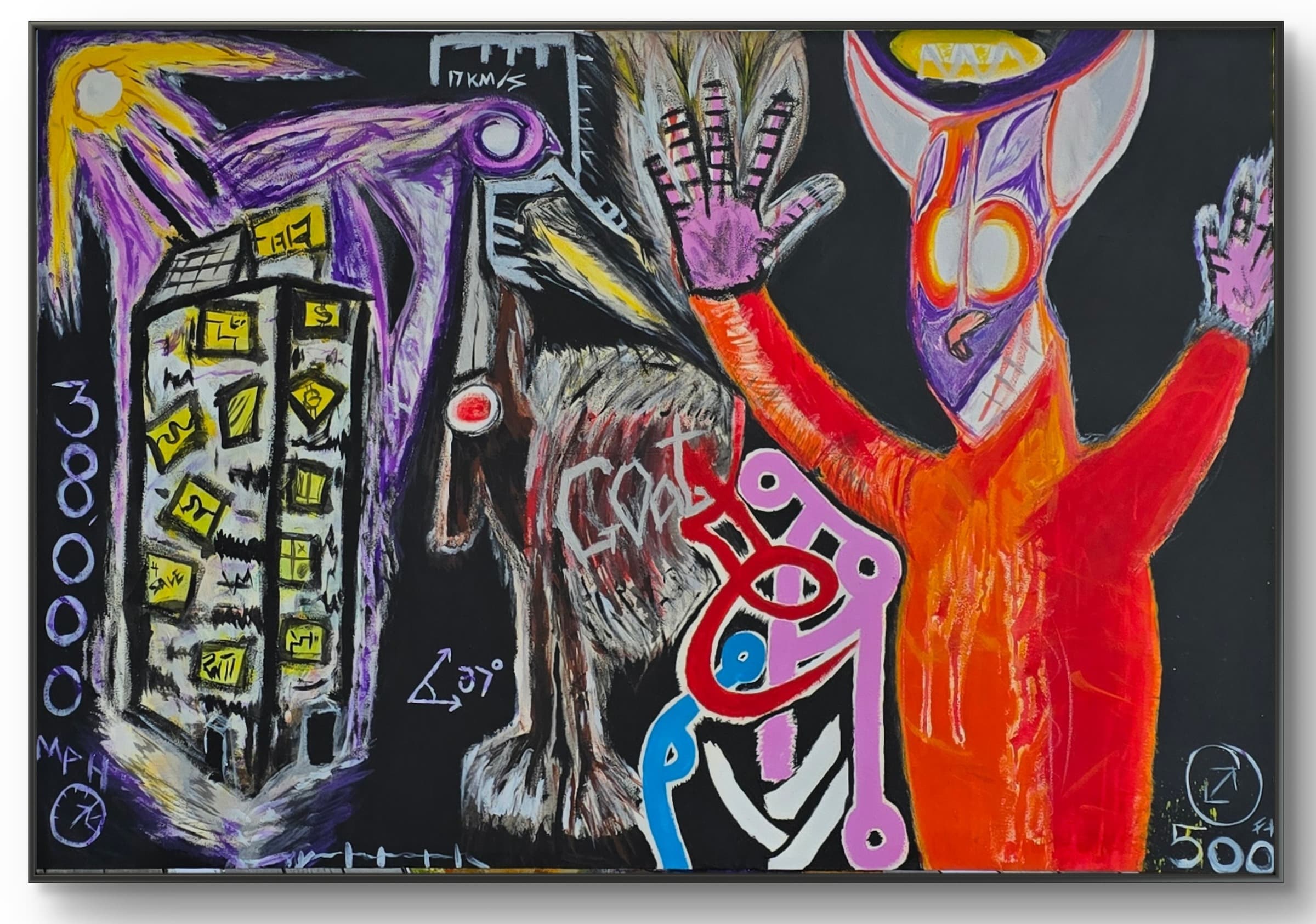
I was painting shadows, not trying to form anything, and a character started coming up out of them on its own. Horns — clearly a devil. But as he came alive he was, unmistakably, happy. Arms up in the air like he was greeting me. Hey. I see you. I'm here. Like he wanted a hug. A goat lay sprawled beside him.
I'd been carrying the old story of the falling-star god for years — the one who comes down as cataclysm and revelation, the destroyer who clears the ground so something new can be forged. I call him Apophis. I believe these arrivals are real, that they've happened before, that we turned them into myth and then into gods and then into dogma until we forgot why the falling star ever mattered — that we're handed our most ruinous seasons to furnace the new. That's mine to believe, not yours to take as fact. But it's why the character means what he means to me.
And Apophis came up out of the shadow looking like everything we're taught to run from, and he was smiling at me like a friend. That's the whole thing in one face. The thing with horns, glad you came.
A year of this has done something to me. I'm less afraid.
The urgency I paint with — fast, like there isn't enough time, because there isn't — is the same urgency as the people who pressed red ochre into a cave wall: I was here. This was my experience, set down in symbols so it outlasts me. That's the oldest thing a human hand has ever wanted to say, and it's still the thing mine is saying.
It's changed how I am with people, too. I'll be honest — I spent years not liking most of them, and on a bad day I still don't. But sitting this close to death has made me want to understand the rest of you: your losses, the family and friends you're quietly burying, the fact that almost everyone walks around with a smile on while a whole weather system of grief moves behind it. We all do the death-with-a-smile thing. Most of us just never say so.
So here's what I want, if you ever stand in front of Apophis carrying your own fear of the end. I want the unrecognizable thing to bring up an unshakable faith. Because the closer I sit with death, the more it reads to me as a divine experience — proof that I was never in control, that I can set the whole weight down and surrender it to something larger than me. I've stopped believing these things only happen to me. They happen for me. For us. I think consciousness is climbing some long spiral toward wholeness, and that even the falling star is part of the climb.
I built a studio full of friends who wear the faces of everything I'm afraid of. Every morning I go and sit with them, and they smile at me, arms open. And every morning I'm a little less alone with the dark — which, it turns out, was the only thing I was ever really afraid of.